


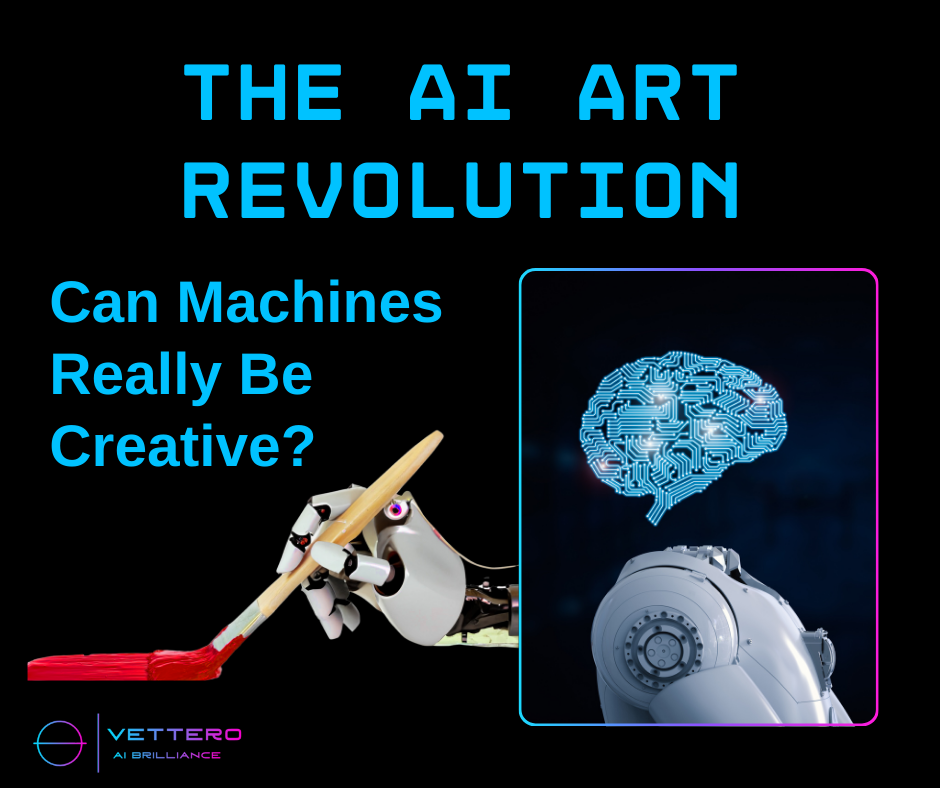
The AI Art Revolution: Can Machines Really Be Creative?
There was a time when creativity was the sacred domain of human beings. Art, music, design—these were expressions of emotion, soul, and consciousness. Then came AI. And suddenly, machines were painting portraits, composing symphonies, and designing logos. Naturally, the world started asking: Can machines really be creative?
When an AI generates a painting, is it art? Critics argue that AI merely remixes existing human creations, while enthusiasts see it as a new form of collaboration. Here’s my take: AI is like a boundless, hyper-fast apprentice. It can produce a thousand variations in the style of Van Gogh or Picasso, but it doesn’t feel the urge to create—it responds to prompts.
I’ve asked myself the same question more than once.
Yet, the results can be breathtaking. Tools like MidJourney and DALL-E have helped our startup prototype branding visuals in minutes, something that used to take days (and costly freelancers). For small businesses, this is revolutionary.
When I first saw an AI-generated painting sell for hundreds of thousands of dollars, I felt a mix of awe and unease. As a creative myself, it felt personal. But over time, as I worked more with AI tools, I started to shift my perspective.
But it also raises questions: Where do we draw the line between inspiration and plagiarism?Let’s explore how AI is reshaping the creative world—and why it might be more collaborative than we think.
AI in Art: From Code to Canvas
AI-generated art isn’t just a novelty anymore—it’s a movement. Algorithms trained on thousands of pieces of visual art can now create entirely new images in various styles.
🎨 I played with an AI art generator once out of curiosity. I typed in "a stormy sky over a lonely cabin" and within seconds, I had several stunning, unique visuals that looked like they came out of a gallery. Was it perfect? Not always. But it sparked ideas. It inspired me. And that’s where the magic lies.
For designers and content creators, AI isn’t here to replace your brush strokes or intuition—it’s a powerful collaborator that speeds up ideation and experimentation.
AI in Music: The Algorithmic Composer
If you’ve ever heard an AI-generated music track, you might be surprised at how... human it sounds. Tools like AIVA, Amper, and Google’s MusicLM can compose original music based on mood, genre, or even a few text prompts.
🎶 I once used an AI music tool to create background scores for a presentation. It nailed the vibe better than any stock music I could find. And no, it didn’t feel soulless—it felt custom.
But here’s the catch: while AI can analyze patterns in thousands of songs to create something pleasing, it doesn’t write lyrics about heartbreak after a 2 a.m. whiskey. That raw, human emotion? Still ours. For businesses, though, AI music is a goldmine. Imagine scoring your podcast intro or ad campaign for pennies, without licensing headaches.
For musicians and sound designers, AI can generate baselines, harmonies, or rhythm suggestions. It won’t write your next heartbreak ballad, but it might help you structure it.
AI in Design: Creativity at Scale
One of the biggest benefits AI brings to design is speed and scalability. Need 50 logo variations? AI can do that in minutes. Want a color palette based on your brand mood? There's a tool for that.
🖌️ I personally love using AI to generate mood boards. As someone who can get creatively stuck, having a visual springboard helps me find direction faster. It doesn’t replace my taste or final decisions—it just gives me options.
Today, AI tools like Canva’s Magic Design or Adobe Firefly can whip up logos, social media templates, or even full branding kits in seconds. For solopreneurs and startups, this is empowering. No budget for a design team? No problem. But as a creative myself, I’ve noticed something crucial: AI lacks intent. It doesn’t choose to break rules for impact or obsess over kerning at 3 a.m. That’s where human designers still reign supreme—they don’t just make things look good; they make them mean something.
AI is especially useful for small businesses or startups without big design budgets. You can get high-quality design assets quickly and affordably, freeing up time and resources.
So... Can Machines Really Be Creative?
Let’s address the elephant in the studio: Is AI coming for creative jobs? In some ways, yes—but not how you’d fear. It’s automating the tedious parts (think resizing 100 social media images) and democratizing access. A bakery can now generate stunning cupcake ads without hiring a pricey agency.
Here’s where things get interesting. AI doesn’t create from emotion, personal experience, or existential musings. It creates from data. It doesn’t feel, but it can mimic the results of feeling based on patterns, styles, and feedback.
But the soul of creativity? That’s still human territory. The most successful AI-assisted projects I’ve seen blend machine efficiency with human curation. For example, our team uses AI to draft initial design concepts, then adds strategic tweaks that only a human would consider (like cultural nuances or brand personality).
So while AI might not experience heartbreak, it can still compose a song that makes you feel heartbroken. And maybe that’s a new kind of creativity—one rooted in collaboration rather than competition.
Human + AI: The Ultimate Creative Team
The real power of AI lies in augmentation, not replacement. I see AI as the ultimate creative sidekick:
- It doesn't suffer from creative block
- It works fast
- It gives you more to work with, not less
Think of AI as the rough sketch artist, and you as the painter who brings it to life. Or the rhythm section to your melody. Or the muse who never sleeps.
A Personal Take: Finding My Creative Flow Again
There was a point where I felt burned out creatively. Stuck. Then I started using AI tools to help me brainstorm, to generate visuals, to build mood boards, and even to explore ideas I never would have considered. And slowly, my spark came back for writing,in fact dare I say, my writing has since improved in areas where I was weak at because I could study the art of it.
AI didn’t take over my art—it helped me rediscover it.
Final Thoughts: Creativity, Redefined
The AI art revolution isn’t about machines taking over creativity. It’s about expanding what creativity can be. It’s about giving artists, designers, musicians, and storytellers new tools to push boundaries.
So can machines really be creative? On their own, maybe not in the traditional sense. But when paired with human emotion, intent, and vision?
Absolutely.
Curious to explore this space? Try a free AI art tool or music generator. Create something. See how it feels. And don’t be afraid to collaborate with your newest, most efficient creative partner.